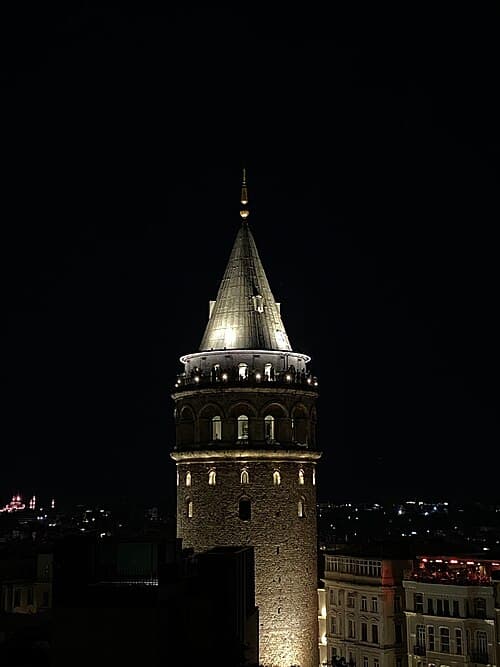
Galata Tower
A Genoese stone tower from 1348 in Istanbul's Galata district, now a museum with a 360-degree view over the Golden Horn and the Bosphorus.
Walk up from Karaköy and Galata Tower (Galata Kulesi) appears at the end of a narrow street. This stone tower in Istanbul's Beyoğlu district has watched over the Golden Horn for almost seven centuries. From its top balcony, the old city, the Bosphorus and the Asian shore line up in one view.
Galata Tower history
The Genoese settled in Galata in 1267 under an agreement with Byzantium. They walled their colony and, in 1348, built this tower at the highest point of the walls. They called it Christea Turris, the Tower of Christ. An earlier Byzantine tower is known to have stood on the site.
When the Ottomans took Constantinople in 1453, the Genoese of Galata surrendered without a fight. Over the following centuries the tower served as a prison and, from the 18th century, as a fire lookout. An earthquake in 1509, fires in 1794 and 1831 and a storm in 1875 all damaged it. Each time it was repaired, and its roof changed shape more than once.
The conical cap you see today dates from the 1965–1967 restoration, when the wooden interior was replaced with concrete and the tower opened to visitors. In 2013 it was added to UNESCO's Tentative List of World Heritage Sites.
The legend of Hezarfen Ahmed Çelebi
The tower's most famous story comes from one source: the travel writer Evliya Çelebi. According to his account, in the reign of Murad IV, Hezarfen Ahmed Çelebi strapped on eagle-like wings, jumped from the tower and glided across the Bosphorus to Üsküdar. The sultan is said to have rewarded him, then exiled him to Algeria as too dangerous. No other contemporary record confirms the flight. You can decide for yourself.
Locals add a softer legend. Galata Tower, the story goes, is in love with the Maiden's Tower across the water. Another belief says couples who climb the tower together for the first time will marry.
Inside the Galata Tower museum
For decades the tower housed a restaurant and nightclub. In 2020 the Ministry of Culture and Tourism removed them and opened Galata Tower as a museum on 6 October 2020. After roof repairs and earthquake strengthening, it reopened on 25 May 2024.
A lift takes you most of the way up; the last floors are on foot. Exhibits cover finds from Istanbul's archaeological past, the Golden Horn chain and a display on Hezarfen's flight. The narrow balcony at the top shows Topkapı Palace, the Süleymaniye Mosque and the mouth of the Bosphorus.
Galata Tower tickets and visiting tips
The tower stands on Galata Tower Square in Beyoğlu. The nearest stops are Karaköy on the T1 tram and Şişhane on the M2 metro. From Karaköy it is a ten-minute uphill walk.
Entry is by ticket. For current Galata Tower tickets and opening hours, check the Ministry of Culture and Tourism's official museum website. Visitor numbers can be capped per hour, so queues build in summer and at sunset. Early mornings are calmer.
Frequently asked questions
How much are Galata Tower tickets?
Galata Tower is a ticketed museum. Prices change, so check the Ministry of Culture and Tourism's official museum website before you go.
When was Galata Tower built?
The current tower was built by the Genoese in 1348 at the highest point of Galata's walls. It was originally called Christea Turris, the Tower of Christ.
Did Hezarfen Ahmed Çelebi really fly from Galata Tower?
The only source is the 17th-century travel writer Evliya Çelebi. He says Hezarfen glided from the tower to Üsküdar, but no other record confirms it.
Is there a lift in Galata Tower?
Yes. A lift takes visitors up most of the way, and the last floors to the balcony are reached by stairs.
How do I get to Galata Tower?
Take the T1 tram to Karaköy and walk uphill, or take the M2 metro to Şişhane. Both are within about ten minutes on foot.